










Official vocational qualifications for the wood sector
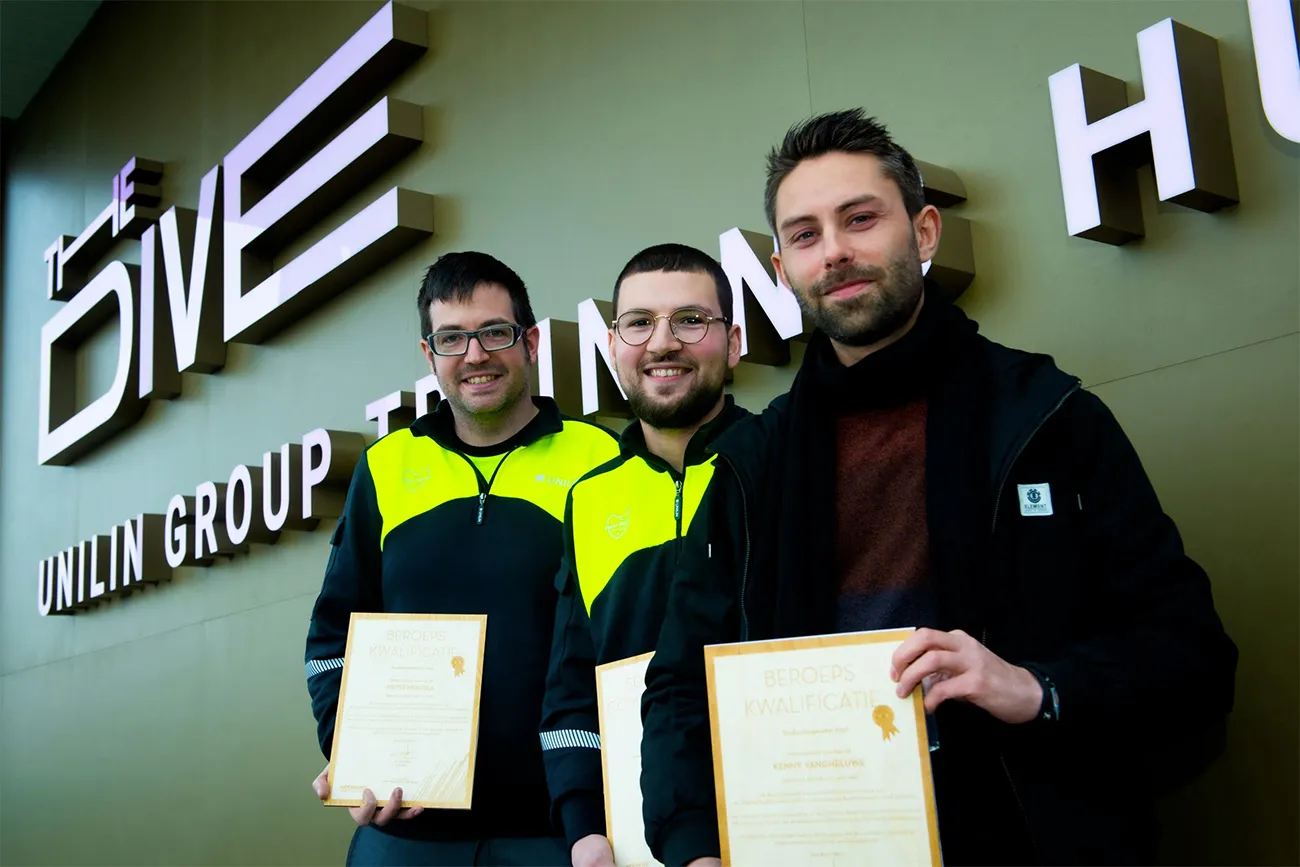
Until now, what employees learned on the job went unrecognised. This was happening in a tight labour market where employers are increasingly training their employees as they go. The sector organisation Woodwize is changing that. Together with partners, Woodwize has developed workplace training that leads to a vocational qualification equivalent to a diploma in the sector. Mathijs, Erwin, Kenny, Pieter and Ali started working in the wood sector without a diploma or after following a very different path, and were the first to complete the training programme. They can now rightly call themselves Wood Production Operators or Machining Joiners.
At the first presentation of individual vocational qualifications last week, Minister Jo Brouns highlighted the importance of this new approach. “Flanders still has a long way to go when it comes to lifelong learning and workplace learning. The workplace is Flanders’ biggest school. With these workplace-based vocational qualification programmes, Woodwize is bringing this type of learning into the spotlight for the first time.”
A vocational qualification on a par with other diplomas
Bart De Waele, project coordinator for the ESF project “WPL4BK: Levenslang gekwalificeerd werkplekleren in de houtsector”, presented the first qualifications to the five pioneers. “Working with Bours, Decadt, De Stoffeerder, Galle houtbewerking, Lenzo, Unilin, the social learning centre De Sluis and VDAB, we developed four qualifying training programmes that are accessible to both small and large businesses. We now recognise around 238 workplace learning modules. If a participant is not required to complete the full programme, or does not have time to do so, they receive a sectoral competence certificate for the modules they have completed. Over the past two years, these efforts have enabled 33 employees to undertake qualifying workplace training. Five of them were awarded a full vocational qualification ahead of schedule. They now appear alongside other graduates in the Flemish authorities’ LED (Leer- en Ervaringsbewijzen) database. From now on, learning on the job counts just as much as learning in the classroom.”
Confidence in the team
23-year-old Mathijs Guerboo works at Boomzagerij Decadt in Vlamertinge and was the first to gain a vocational qualification as a Wood Production Operator. “Thanks to this qualification, my tasks are even more varied. I can now operate, programme and maintain the entire sawmill line. I can even fill in for the sawmill coordinator when he is away.” Managing director Stefan Decadt sees the added value of employees with a vocational qualification. “The qualification gives me confidence. I know my employees are well trained and will always deliver the quality we expect.”
External recognition for in-house training
Unilin, which uses wood as a raw material for some of its products, already offered a wide range of in-house training and has now adapted it to meet the sector’s requirements. Bart Den Tijn, head of training at Unilin in Wielsbeke: “Our in-house training is now ready to lead to a qualification. It therefore also has external value.” For Pieter Mekeirle, who previously worked in the chemical industry, the training programme came at just the right time. “I want to do my job as an operator properly. I think it’s ideal to have a plan showing which skills I need to learn, at my own pace, and to have support along the way. This training is wonderful recognition of the work I’ve put into changing careers,” says Pieter.

Everyone benefits
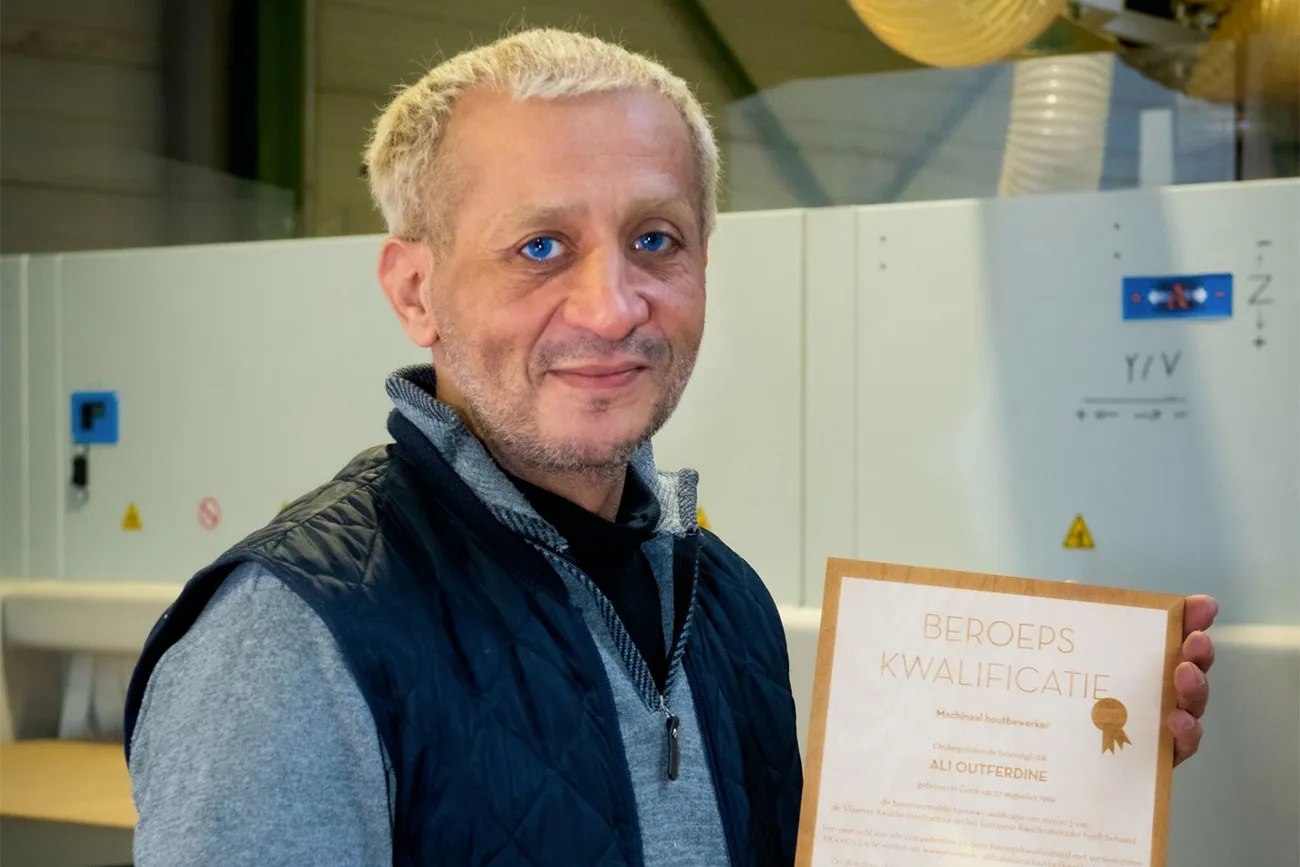
Ali, a bespoke joiner at the social learning centre De Sluis in Genk, also learned on the job and is now proud to hold a vocational qualification as a Machining Joiner. Kim Cuypers, coordinator at the non-profit organisation De Sluis: “Employees in our bespoke department often have a special education diploma and sometimes find it difficult to find their feet. This recognition from the sector gives them an incredible boost.” “When an employer is unsure about hiring someone, this qualification can convince them to give that person a chance,” adds Bart De Waele of Woodwize. “And every new employee is an asset.”
Strengthening the sector
Employee organisations in the furniture and wood sectors see an increasing need for workplace learning in their fields. “On the one hand, we see a disconnect between education and the labour market. On the other, we know that jobs are constantly evolving technologically. Finally, many young people enter the labour market without a diploma. With stronger skills, they can be a great fit for our sector. These three factors make workplace learning essential. Through structured, recognised training programmes tailored to learners and businesses, and delivered at their own pace, we want to promote this type of learning,” explains Wim van Goethem, training coordinator at Fedustria. “Supporting this pathway means offering a future. The better the training, the stronger the sector. In-house support for employees is the best school, but combined with support from the sector, we have everything we need to guarantee quality in the long term,” concludes Pascal Mageren of the Belgian Wood Confederation. ■
Question about this story? Ask your question
Keep following this
Get an email when a new story is published. No account needed.
- ThemeTimber and panels under pressure
- SubjectNews