










Moving towards eco-design in the wood and furniture sectors requires technical and scientific expertise
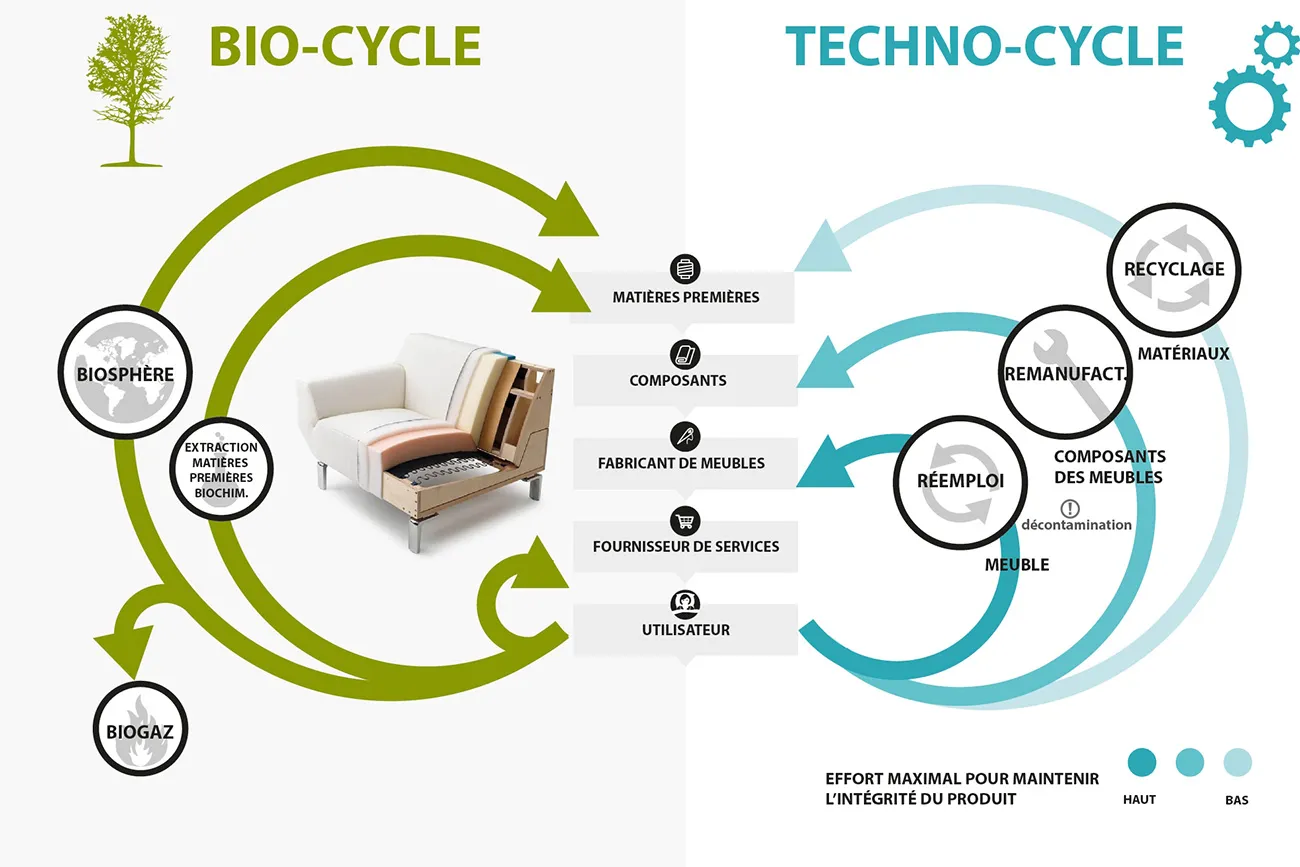
Eco-design guidelines: from design through to reuse or recycling
At WOOD.BE, eco-innovation is one of the pillars of innovation as a whole, and eco-design is an important link in the chain for any manufacturing business in the wood and furniture sectors looking to innovate while reducing its environmental footprint. For this sector, WOOD.BE has drawn up eco-design guidelines for use in workshops with businesses.
The research centre WOOD.BE supports businesses in the wood and furniture sector as they transition to eco-design, through collective and sector-wide projects or tailored services and support, ranging from monitoring developments in a particular field to providing follow-up during the launch of a new product or service. “Among our sector-wide projects, we are currently working with the mattress sector on programmes under the EPR scheme (extended producer responsibility), which was recently introduced in Belgium (the Valumat design-for-circularity project),” explains Susanna Campogrande, innovation expert at WOOD.BE. “We support the Valumat compliance scheme, which is responsible for the collection and end-of-life management of mattresses, encouraging manufacturers and the entire value chain to adopt a circular approach by providing recommendations on eco-design and reuse, helping to create a materials passport, and using tools such as LCA (life cycle assessment) to quantify environmental impacts.”

What does eco-design involve?
An eco-design approach means taking a product’s or service’s environmental impact into account throughout its life cycle, while preserving its functional and aesthetic qualities, from the design stage onwards. At the product or service design stage, it is possible to influence the choice and origin of materials, how they are processed, how the product is transported, how it is used for as long as possible, and how it is subsequently reused and recycled. “In reality, we should not even talk about eco-design, but simply good design.
Likewise, we can never say that a product is ‘eco-friendly’, as this is a relative concept: we can say that one product is more environmentally friendly than a similar one, but never that it is eco-friendly in absolute terms,” says Susanna.
A good starting point for a business embarking on eco-design is to carry out an environmental assessment of its existing products. Life cycle assessment is a good way to do this, as it highlights the critical points and weaknesses in a product’s production or use cycle. “Eco-design is therefore a multi-stage, multi-criteria and multi-stakeholder process.”
Businesses looking to integrate eco-design into their production generally aim (1) to optimise resources by minimising waste, (2) to maximise recycling, (3) to reduce energy consumption during production and transport, and (4) to improve their products (and their image) in response to growing market demand for sustainable development. Eco-innovation has for some time been a factor in competitiveness and innovation, but the risk of greenwashing remains a concern.
Why work with WOOD.BE?
WOOD.BE knows the sector and its technical centre brings together a mix of expertise, ranging from technical and scientific knowledge of wood and its production to innovative business models and market knowledge. Susanna says: “We have tools to support businesses, acting as facilitators for working groups, including our guidelines and the design thinking method. These guidelines cover a wide range of criteria relating to the different stages in a product’s life and involve all the stakeholders across the value chain. In the wood and furniture sector, to give a few examples, there are businesses such as brands and furniture publishers that do not manufacture in Belgium but work within a local subcontracting ecosystem for activities such as supply, distribution, logistics, design, communication, as well as repair, recovery and recycling. It is therefore important to transform the entire value chain in order to move towards genuine eco-design.”
Question about this story? Ask your question
Keep following this
Get an email when a new story is published. No account needed.
- ThemeBetter workshop production
- SubjectNews