










Construction confidence barometer in the red

Confidence among building contractors has fallen sharply. This is reflected in Bouwunie’s construction confidence barometer, which was in the red in the first quarter of 2022. This means building contractors have a much less positive view of the economic situation. The rising costs are, of course, a major factor.
Bouwunie’s barometer fell from 99.9 to 98.5 in the first quarter of 2022, moving further into the red. By comparison, it had still recorded a very positive result of 101.3 in the second quarter of 2021. The reason is easy to understand: steep cost increases and pressure on prices.
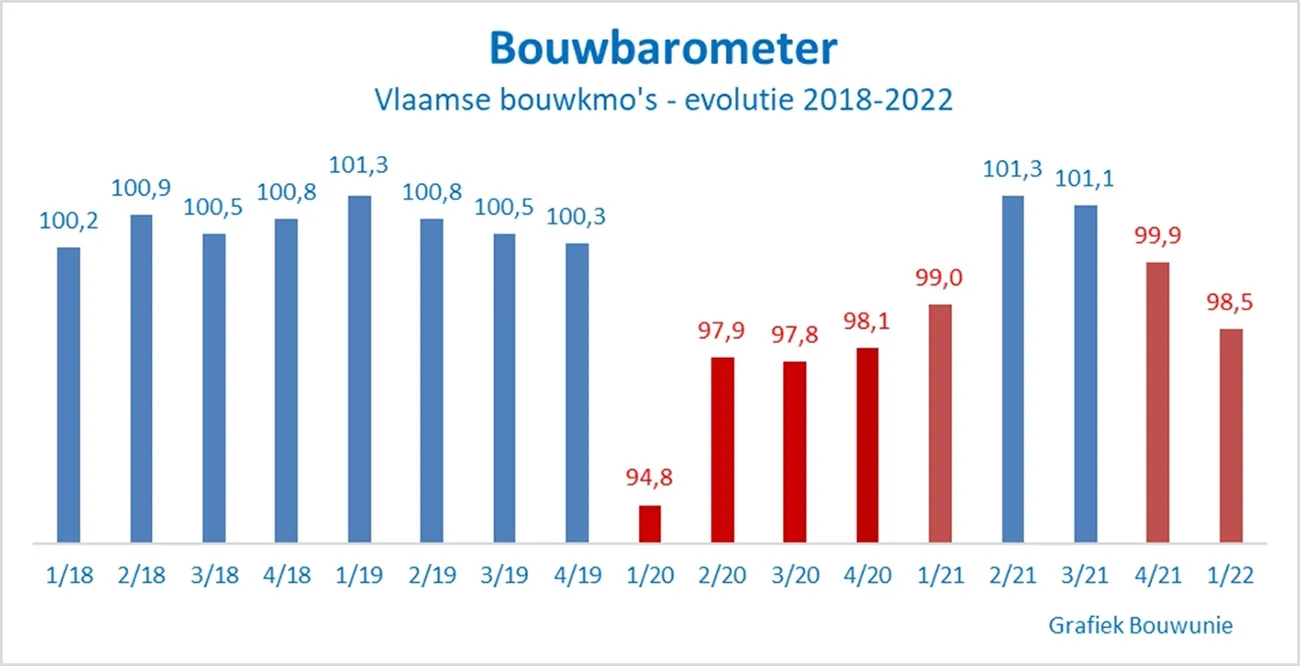
Confidence wanes
One thing to note, however: this construction confidence barometer dates from March 2022. But there is no immediate improvement in sight, quite the opposite. The many price and cost increases are eating into the profitability of construction companies. Four in ten report a further deterioration. At the end of March, order books were still well filled: one in three construction companies said it had enough work for at least six months. But if confidence among households and businesses stays at its current level, that could soon change. Uncertainty caused by Covid, the war in Ukraine, supply problems and rising prices is taking its toll. “Prices are rising across the board: timber, insulation, glass, aluminium, concrete,” says Bouwunie. “The scale of the increase, which ranges from 10 to 50%, depends on the product and the supplier. Another problem is that practically all materials are now subject to delivery delays.
For some products, such as roof tiles, production was even halted for a time. Suppliers are no longer willing or able to give delivery times. The result is delays or even work coming to a halt on site. On average, lead times are six weeks longer than before, although this also depends greatly on the product.”
Passing costs on to clients
What are the consequences? More and more construction companies have no choice but to pass material price increases on to clients. In two thirds of new contracts, material price increases are passed on to the client, most often in full, according to the Construction Confederation’s monthly business survey, in which 325 building contractors took part between 9 and 17 May. In 44% of cases, construction companies pass material price increases on to clients for contracts already in progress. The increase is more often passed on in part (27%) than in full (17%). “This figure will continue to rise as long as construction material prices keep soaring,” says Niko Demeester, Managing Director of the Construction Confederation. “That is why we recommend including a price revision clause in every contract.” This, of course, increases uncertainty for the client. In some cases, projects will have to be postponed or cancelled. “We are already seeing signs in industrial construction that many projects are being postponed,” confirms FAC, the Belgian Federation of Aluminium Constructors.
On site
Jan Ooms, co-manager of the construction and interior design company Ooms Woonrealisaties: “As well as the cost of the materials themselves, surcharges for transport and energy are also driving up bills.” This situation, combined with material shortages and uncertain delivery times, has led Ooms Woonrealisaties to take a different approach to stock management. “Not only do we order everything much earlier than before, we have also significantly increased our stock of price-sensitive materials.” In addition to building materials, Ooms Woningrealisaties has also experienced delivery problems, particularly with kitchen appliances. “These are currently being ordered almost a year in advance. To be on the safe side, we have the appliances delivered and store them in our warehouse. Previously, appliances were ordered as needed, but that stopped working at a certain point. We want to take the pressure off our client, which goes hand in hand with careful planning and reliable delivery times. Hence these solutions, which we hope are temporary, although no one has a crystal ball and we do not know what the future holds.”
Question about this story? Ask your question
Keep following this
Get an email when a new story is published. No account needed.
- SubjectNews